Ultrafast Chirality
for Life and Technology
Harnessing attosecond electron dynamics to detect molecular handedness — with unprecedented precision, speed, and sensitivity.
Transforming our ability to see, understand, and harness molecular chirality.
Life is chiral. From the structure of proteins and DNA to the functioning of cells and the action of medicines, molecular handedness is a fundamental hallmark of living matter. Changes in chirality are linked to disease, influence biological activity, and determine the effectiveness of many pharmaceutical compounds. Yet detecting and understanding chirality remains one of the great challenges of modern science and technology.
TRILOGY brings together leading academic institutions and industrial partners to pioneer a new generation of ultrafast chiral technologies. By harnessing attosecond electron dynamics—the fastest processes in nature—we are developing entirely new ways to detect, image, and control molecular chirality with unprecedented sensitivity and speed.
Traditional optical methods are fundamentally constrained by the mismatch between the size of molecules and the wavelength of light. TRILOGY overcomes this limitation by directly accessing the ultrafast electronic motion that underlies chiral response. This breakthrough enables chiral signals that are orders of magnitude stronger than those available through conventional approaches, opening new opportunities for biomedical diagnostics, molecular analytics, and advanced photonic technologies.
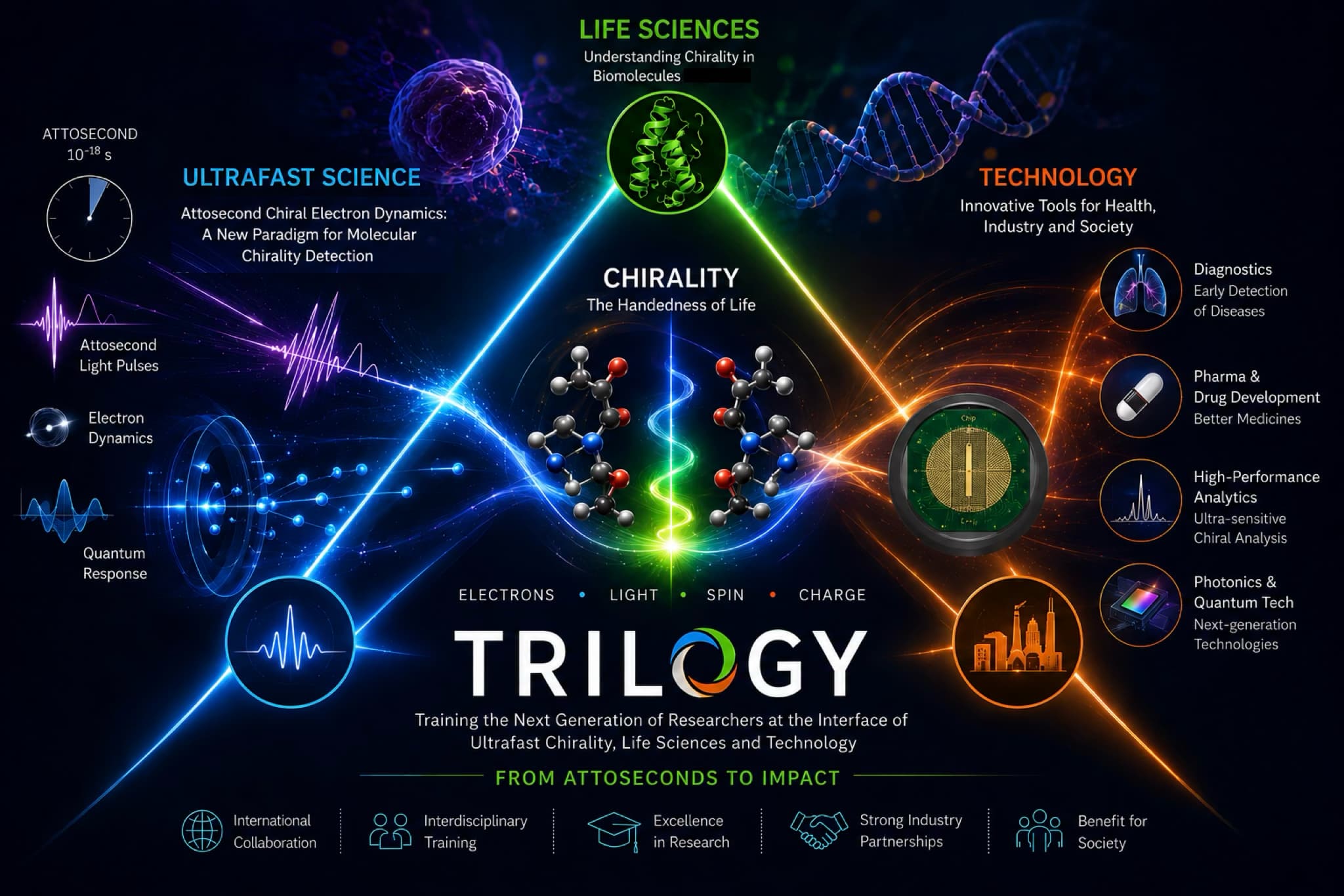
Our research spans the full innovation chain: from fundamental studies of electron, charge, and spin dynamics in chiral matter to the development of next-generation analytical tools for life sciences and industry. Together with world-leading industrial partners in mass spectrometry, laser technology, and high-performance imaging, we aim to accelerate the translation of frontier scientific discoveries into practical technologies.
At its heart, TRILOGY is a training network. We will educate a new generation of doctoral researchers with expertise that bridges physics, chemistry, biology, photonics, data science, and industrial innovation. Through interdisciplinary research, international collaboration, and close engagement with industry, our researchers will help shape the future of chiral science and its applications for the benefit of society.
Work Packages
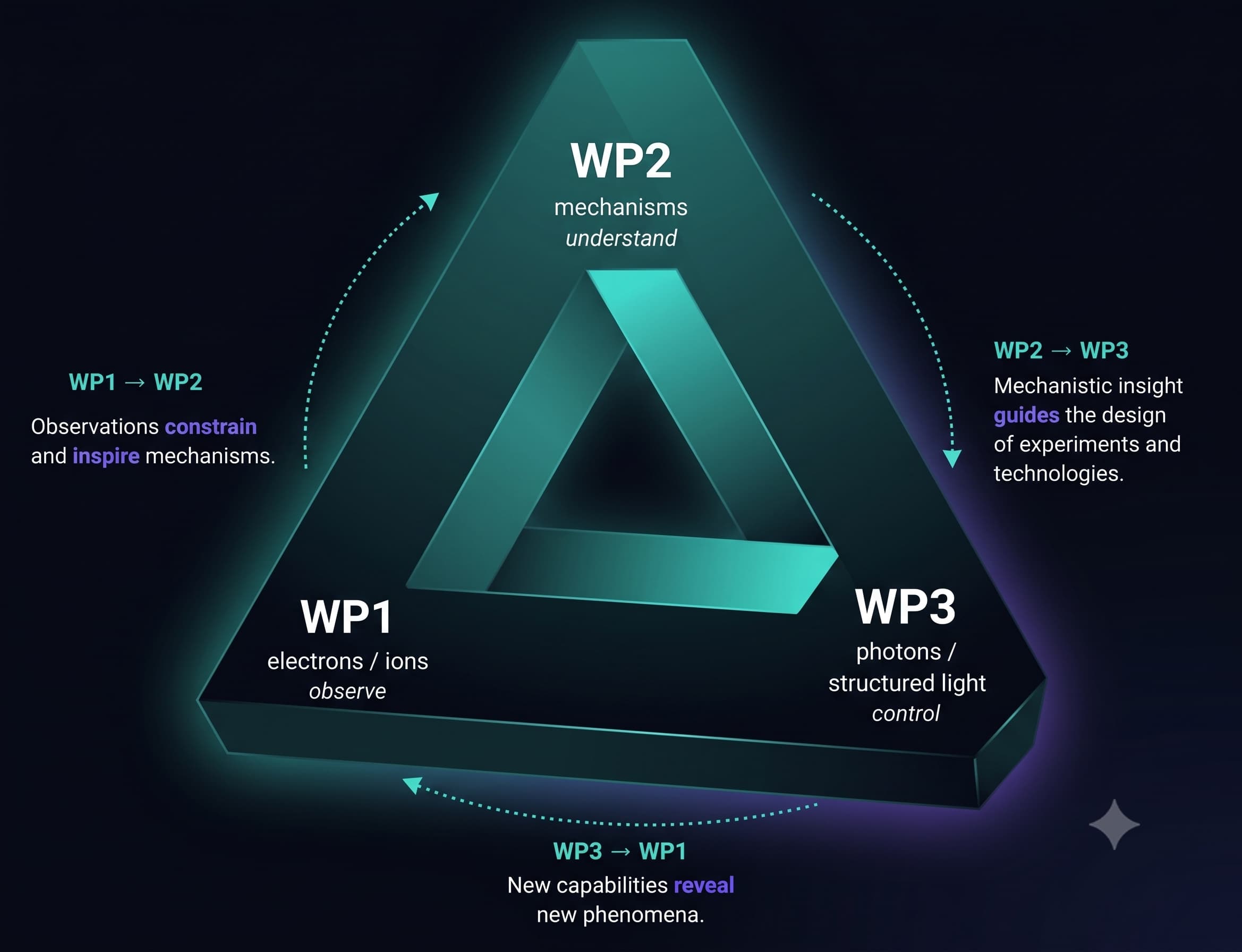
TRILOGY is structured into five interconnected work packages spanning fundamental science, technology development, and researcher training. (Hover over the WP numbers for more info).
WP1 : Chiral Detection through Electrons and Ions
Ultrafast electronic currents carry a detailed fingerprint of molecular structure. WP1 develops next-generation chiral sensing methods by mapping these currents onto photoelectrons and ions, combining photoelectron circular dichroism with high-resolution mass spectrometry. The goal is rapid and highly sensitive identification of molecular structure, conformations, and handedness in complex biological and pharmaceutical samples.
WP2 : Quantum dynamics of Ultrafast Chiral Currents
WP2 explores the fundamental quantum physics of chiral electronic, vibronic, and spin currents. By uncovering how molecular handedness shapes charge migration, spin polarization, geometric phases, and topological observables, it establishes the theoretical foundations of ultrafast chirality and reveals new mechanisms for controlling molecular dynamics with light.
WP3 : Synthetic Chiral Light and Photonic Technologies
WP3 harnesses synthetic chiral light and advanced photonic technologies to enhance, control, and read out chiral responses. By engineering the temporal and spatial structure of light fields, it creates powerful new tools for chiral spectroscopy, imaging, and sensing, paving the way toward compact photonic platforms for real-world applications in health, industry, and environmental monitoring.
Nodes & Institutions
TRILOGY brings together 11 beneficiary institutions — including universities, research organisations, and high-tech industry partners — spanning 8 countries across Europe, the UK, and Israel.
The network is complemented by 12 associated partner organisations, including world-leading research institutes, technology companies, and publishing infrastructure.
Industry participation is embedded at the core of the network. ThermoFisher Scientific, Amplitude, and PI Imaging Technology offer secondment placements and co-supervision, ensuring that doctoral research is directly shaped by real-world technology needs.
A dedicated training programme structured around the consortium's geographic and disciplinary breadth ensures each doctoral candidate participates in at least two research environments during their fellowship.